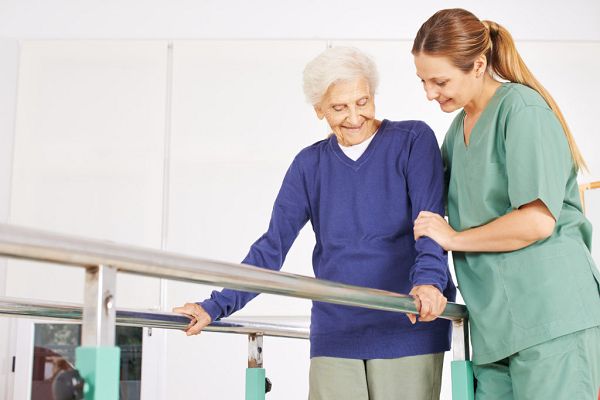
In India, Stroke is one of the leading causes of death as well as disability post survival. Beyond the age of 55yrs, 1-5 women and 1-6 men are at risk of Stroke, which is caused due to the blockage of blood vessels that transport blood to the brain. Stroke however is not bound to be a disease of the old age, it can happen to anyone. Most stroke survivors wish to live independently in their own homes; however, even with the help of family caregivers, recovery remains quiet the challenge.
Rehabilitative Therapy commences in the hospital when a patient becomes stable. On discharge, medics help in the planning of continued rehabilitation and care. Rehabilitation helps patients achieve their optimal physical potential and functional independence. Several Stroke survivors are able to make a full recovery with miniscule long-term effects. Each form of treatment is designed, reviewed and renewed periodically; safety is ensured by monitoring patient vitals regularly. Depending on an individual’s needs, rehabilitation at home may include:
Physical Therapy – Physical Therapists use techniques to facilitate relearning of movements, prevent complications like tight muscles and stiff joints; it also enables balance and coordination of limbs. A mirror is used in correcting the posture during standing or walking. Mentally rehearsal of a movement is utilized as a tool to enhance ones therapy.
Occupational Therapy- This enables an individual to develop and adjust to skills required for daily activities such as eating, dressing, etc.
Speech or Communication Therapy– Is deployed to recuperate from slurred speaking and recover from swallowing problems.
Mental and psychological counseling– Is also of utmost importance, this helps patients cope with emotional and behavioural challenges.
Here’s what survivors along with family member and caregivers can do to increase self-dependency and function.
– Splints are used in Neuro-Rehabilitation to manage pain, Hypotension, Spasticity, etc. One must learn to apply these with complete knowhow of when, how, and for how long
– Therapeutic Positioning- Pillow placements while patient is lying/sitting
– Carefully handling the shoulder to prevent dislocation
– Adhere to safety precautions while moving at home or outdoors, to prevent falls
– Transfer of strength achieved during therapy to functional activities is of utmost importance. Patients and caregivers must reinforce the use of weaker arms or legs. For example, lifting the arm during upper body dressing
– Encourage use of affected side during the day
– Learn correct techniques to transfer the patient from the bed or wheelchair, to prevent back pain
– Encourage and motivate the patient often
– Modifying your home appropriately to make it convenient for Stroke survivors; install railings on stairways, handle bars, non-skid mats and elevated toilet seats
– Fatigue affects motor performance, hence intermittent rest is important
What are the top progress markers during home rehab? Progress markers will vary from case to case basis, but here are some key generic markers of progress. Your Physiotherapist should be consulted about these; Maintenance of Joint mobility.
– Absence of pressure sores
– Improvement in movement control
– Improved balance
– Ability to carry out self-care without assistance (feeding, bathing, toilet activities, upper and lower body dressing)
– Indoor and or outdoor mobility
– Return to work/leisure activities.
Why is home rehab important? The rate of recovery is faster in the first 3 months, thereafter it slows down. In sub-acute and chronic stage it may not be possible, medically, for one to visit the nearest Physiotherapy OPD set-up, this makes rehabilitation essential in the initial stages. Home rehabilitation helps the patient learn transfer techniques specific to his/ her needs. The goals of therapy are focused on improving activities limited due to impairments such as dressing-upper body, lower body, feeding, standing to sitting control at different heights, etc. Continuity of care helps maintain and improve joint mobility, review by the Therapist can help change plan of care as per patient’s condition.
While most family members are enthusiastic to participate at the beginning of the rehabilitation program, it is important to help the patient’s only when required, and deter them from becoming overly dependent as soon as they are discharged from the hospital. To reduce caregiver burden, other family members must be involved in the rehabilitation program too.
(Disclaimer: The writer is Dr Shruti Sonar, Physiotherapist, Fortis Hospital, Mulund. Views expressed are a personal opinion.)

 Health Articles | Health News | Healthcare | Wellness | Medical Education | Pharma